Three Guys Golf Blog - 1st Hand Golf Product Reviews
  • Reviews by Product
    • Clubs
      • Drivers & Woods
      • Irons & Wedges
      • Putters
      • Grips & Shafts
    • Apparel
    • Shoes
    • Accessories
      • Headcovers
      • Gloves
      • GPS & Range Finders
      • Assorted Golf Products
    • Bags & Carts
    • Apps
    • Balls
    • Books / Videos
    • Golf Training Aids
    • Lifestyle
    • Golf Course Reviews
    • Women’s Golf
  • Reviews by Company
  • Golf Improvement
  • Travel
  • Interviews
  • Misc
  • Sponsorship
  • Press
  • Sitemap
  • Contact
  • About
Three Guys Golf Blog - 1st Hand Golf Product Reviews
Reviews by Product
    Clubs
    Drivers & Woods
    Irons & Wedges
    Putters
    Grips & Shafts
    Apparel
    Shoes
    Accessories
    Headcovers
    Gloves
    GPS & Range Finders
    Assorted Golf Products
    Bags & Carts
    Apps
    Balls
    Books / Videos
    Golf Training Aids
    Lifestyle
    Golf Course Reviews
    Women's Golf
Reviews by Company
Golf Improvement
Travel
Interviews
Misc
  • Reviews by Product
    • Clubs
      • Drivers & Woods
      • Irons & Wedges
      • Putters
      • Grips & Shafts
    • Apparel
    • Shoes
    • Accessories
      • Headcovers
      • Gloves
      • GPS & Range Finders
      • Assorted Golf Products
    • Bags & Carts
    • Apps
    • Balls
    • Books / Videos
    • Golf Training Aids
    • Lifestyle
    • Golf Course Reviews
    • Women’s Golf
  • Reviews by Company
  • Golf Improvement
  • Travel
  • Interviews
  • Misc
golf Improvement

Importance of Golf Rivalries

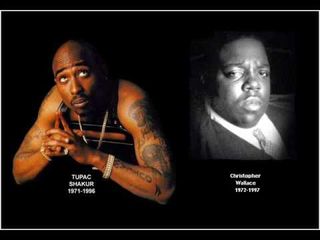
Throughout time, we have cherished the great rivalries: Nicholas – Palmer, Ali – Frazier, Borg – McEnroe, Tupac – Notorious B.I.G..  So I ask, how come only super-stars get rivals?  I mean, if a rivalry makes each player better and matches more exciting, shouldn’t we all have one?

  Don’t we all deserve a rival?

For me, I have two types of rivalries 1) friendly  and  2) not so friendly.  A friendly rivalry is a simple way to add motivation during your weekend round with buddies (a healthy bet will also do the trick).  On the other hand, a “not so friendly” rivalry is where it really gets fun and money is a poor substitute.  It is hard to describe this type of rivalry, but basically it occurs when you end up playing a lot of golf with someone who for some reason you cannot stomach the thought of losing to.  It is the match against the guy who complains about his round no matter what or the guy who thinks he is 3 strokes better than he really is.  Yes, that’s the guy who I want to beat every single time we are in the same foursome. That is the person who I will make my rival.

While playing against a “not so friendly” rival is not something you want to do every day, there is definitely an added thrill to  match where a healthy dose of disdain is involved. I also think that it makes you a better player if you sometimes focus on a match rather than a score.  This is precisely why I think Dylan did not love Kelly nearly as much as he enjoyed knowing he stole her from Brandon (or at least until Kelly decided “I choose me”.  Yup, I am a big believer in rivalries, give it a try and you too may be a convert.


July 26, 2011by Adam Staelin
golf Improvement

The Most Dangerous Time of the Year

Three Guys Golf Blog: I write this post mostly as a reminder to myself, but I suspect it may apply to many of you as well. Each year about this time, my golf game is just about as good as it gets.  For me, this means I am hovering right around the mendoza line of a 10 handicap.  In terms of score, I will shoot between 78 and 83 with the difference being just a few 12 foot putts or a couple of nice chips.

Unfortunately, my brain starts to believe that what I really need to do is just tweak my swing so I can hit the ball a little farther.  Whether that means taking a wider back-swing, making bigger follow through, or focusing on keeping elbows down, each a recipe for disaster when I try to take it to the course.

Three Guys Golf Blog: Storm

The most dangerous time of year is when you are playing your best

Hence, this is why I call this the “Most Dangerous Time of the Year”.  It is the time I need to remember why my game is where it is and resist the urge to change much at all.  Of course, this always begs the question why Tiger would have changed his swing even when he was the most dominate player in the world but that is a different subject and just another one of a million differences between me and Tiger (waitresses excluded).

So this is going to be the year that I do not make any fundamental changes to my swing in late July/August.  Instead, I am going to try and follow my “be the ball Danny” theory.

July 21, 2011by Adam Staelin
golf Improvement

Be the Ball Danny

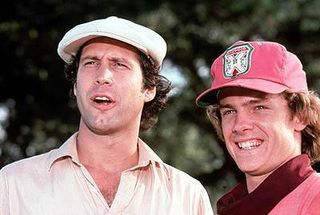
Yes, I know we have all quoted this famous line about a million times, but Ty Webb was on to something.  For me, I rediscovered its value about 3 weeks ago.  This spring, I had been working really hard on improving the mechanics of my swing.  You know, reading tons of magazines, watching YouTube videos and generally obsessing.  Fortunately, it was paying off and I felt like I was getting better.  From May to June I went from shooting mid to high 80’s to low 80’s.  Then in early June, just one day prior to a tournament, I played 12 of the worst holes I had played since February.  I was beside myself and was clueless as to how to fix my swing.  It was on the 13th hole where I decided I was going to finish the round just trying “to make solid contact”.

First a note on “making solid contact”:  I once heard a pro say that all he thought about while standing over the ball was “make solid contact”.  While I neither believe anything a pro says nor think that it has any relation to our game (look for a future blog post on this subject), it did make me think.


Just think about making solid contact and you too can “be the ball”

Back to the story, I finished the last 6 holes 2 over and was just blown away by how natural my swing felt.  Since that 6 hole stretch, I have blocked out any swing thoughts other than “make good contact”. Well, to be fair, I do think about a light grip, but that is not really a swing thought.  In other words,  “Be the Ball”.

I am not sure if this theory works without having a decent swing to begin with, but I believe that over thinking your swing can result in a downward spiral of confusion.  On the other hand, take the act throwing a baseball.   Have you ever thought about the mechanics of throwing a baseball?  Of course not, but anybody with just an ounce of coordination can just pick up a ball and throw it without thinking about mechanics.   While you many not hit the strike zone every time, you are likely not to throw it sideways.  I mean can you imagine throwing it sideways?  Umm,  paging Mr. John Wall.  The point is, if you over analyze, the task sometimes gets a whole lot harder.

So if you get bogged down with swing thoughts on the course, give it a try.  Just think about making solid contact and “be the ball Danny”

July 7, 2011by Adam Staelin
golf Improvement

Don’t Mess with the Cardinal Rule

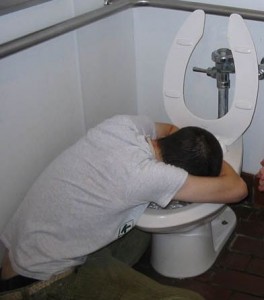
Remember when you were somewhere between 16 and 20 years old and someone told you about not drinking liquor after beer eg (“beer and liquor makes you sicker”)?  Then at some point you tested that theory.  Later that night while hugging the toilet you probably told yourself “never again”.  That is what I call a cardinal rule.  Unfortunately, we tend to break those rules many times before we get the point-Don’t break a cardinal rule.


Be very careful about breaking a cardinal rule

The same goes for golf.  We all have a few cardinal rules, or a least we say we do because we break them way too often.  For example, how many times have you been standing over a shot when your head starts to itch or a bug lands on your ball or some other distraction happens.  The voice inside your head says to back away but, no, you just try to play through it.  The next thing you see is your ball being shanked, honked, bladed, chunked, pulled or sliced.  Then you say, “I knew I should have backed off of that shot!”.  Time to make a cardinal rule-and stick to it!

I only have 3 cardinal rules.  They are:

1) Back away from a ball if a bad swing thought enters my head. By far the hardest rule to keep.

2) Never, ever, ever play out of turn when playing an important match because every time I do, I rush or think about the fact that I am playing out of turn.

3) Mark all putts that are not tap-ins.  (This is a rule I probably break more than any other, but never in tournament play).

Now I cannot tell you what your cardinal rules should be, but I can tell you that if bad things or good things happen every time you do something in particular, then it is time to make a cardinal rule – and stick to it!

June 30, 2011by Adam Staelin
golf Improvement

Swing Timing

Swing Timing:  It seems like you hear a lot about the pro’s getting ‘ahead of themselves’ and the club getting ‘stuck behind them’ when announcers like Johnny Miller are talking during a telecast.  And the result is a ball being hit offline, usually with a push or snap-hook.

In truth, there are timing elements to everyone’s swing, and the interesting thing to me, is that most folks I play with don’t really have much of an idea as to what creates more ‘timing issues’ in their swing, and what could help create less ‘timing issues.’

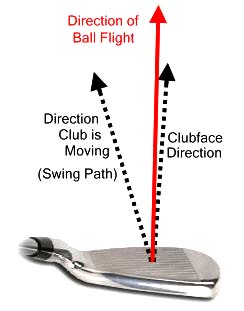
So, to help with defining ‘swing timing issues,’ I would describe them as anything that makes it more difficult to get the clubhead to arrive at impact consistently square to the target, and traveling down the path toward the target. Here’s an example of a minor mis-hit, like most amateurs make:

It’s very clear that there are a number of ways to swing a golf club so that it shows up square to the target line, and traveling down the target line toward the target.  That’s why Arnold, and Lee Trevino, and Jack Nicklaus, and Tiger and Rory all look different playing incredibly great golf.  But there are some fundamentals that make the golf swing easier to repeat, that many folks I play with don’t seem to be aware of; and so they try to copy parts of swings that they see pros make, without understanding what they are looking at, or the particular skills and athletic abilities that pros have, much less the sheer amount of practice and playing that has gone into their careers.  I hear people say things every day like, ‘keep your left arm straight,’ ‘keep your head down,’ ‘bend over more,’ ‘stick your butt out more.’  In my opinion, these aren’t very helpful ideas for creating a more repeating golf swing.

Also, very few amateurs seem to know how to hit a half or three quarter swing, and it seems like you’ve asked them to do something crazy when you bring it up.  I’ll tell you honestly, that the pros that I’ve played with were adamant that if you couldn’t hit a half or three-quarter swing, you didn’t understand your own golf swing—another way to say it is, you have too many timing elements in your swing to repeat it consistently.

Is there any hope of taking some timing elements out of your swing?  I think so, definitely.  Just check out this video of Jimmy Ballard and the role of the left arm:

Golf Tip: Role of Left Arm in Swing; Jim Ballard,

and get to see your local swing guru for a lesson.  They can really help you find the ways to make your swing repeat more often, and you’ll have a lot more fun. As Nicklaus likes to say, ‘It’s not how good your good ones are, it’s how good your bad ones are!’ 

June 27, 2011by Wade Baynham
golf Improvement

The Importance of Hips in the Golf Swing

Three Guys Golf Blog-Hip turn

If you watched any of the US Open last weekend, you are now all too familiar with Rory Mcilroy’s mid-section.  As I noted in an earlier post, I cannot recall being treated to that much slow motion hip movement since a quiet evening in front of Cinemax.


It’s all about hip turn

This brings me to my point, proper hip turn is critical for so many reasons.  First, it is the source of power.  We have all heard about letting the big muscles turn the small muscles but just as important is that a proper hip turn clears the space for you to swing correctly.  Specifically, it allows you to swing on plane rather than over the top.  While I would love to bomb my drives, what I mostly care about is hitting it squarely and that starts with a proper hip turn.

Here is a simple exercise to demonstrate my point.  Set up with a club and take your normal backswing, now rotate your hips to the left and notice how your right elbow drops and how you now have lots of space for the club to pass.  In short, if you get your hips moving first, it puts your body in a much better position to make a good swing.

On the other hand, if you start your swing with your arms, you will most likely come over the top (left shoulder across your body) which is death.

So the quick lesson is, get your hips moving first.  I take no credit for this idea but I will quote Ben Hogan who wrote in his book Five Lessons, “The hips initiate the downswing”. I figure, he was on to something…


June 22, 2011by Adam Staelin
golf Improvement

Know your Golf Stats

If you follow sports at all, you know that statistical analysis has become increasingly sophisticated over the years.  In every sport, player performance is broken down eight ways from Sunday.  Yet, most amateur golfers do not keep any stats.  Yes, some of us may write down how many putts we had on a card but more often than not, it gets chunked at the end of the round.  Moreover, some basic stats, like total putts per round, can be deceiving without a relation to GIR – ie. the more greens  you hit, the more putts you will have.

What do your numbers say about your game?

This year, I have started keeping much better stats and I am convinced it helps me at least understand my game.  I use Golfshot to record stats, but there are tons of other apps available for iPhone, Droid, etc.  What I do, is simply mark each hole with the score, number of putts, and where my drive landed (fairway, left or right). I then transfer that info to Golfshot when I get home.  I could do it on the course with my phone but I think it would mess up my head.

Once you get enough data, you can easily see where your strengths and weaknesses are.  You can also see why you go low one day and not so low the next.  For example, I played the same course twice in the same day about two weeks ago.  I shot an 81 and a 89.  One is 3 strokes lower than my average and one about 5 strokes over my average.  Why?

In both rounds I hit 57% of the fairways.  My recovery performance was also very similar (the number of times I got up and down).  However, in the low round I hit 3 more GIR. Moreover, in the low round I averaged nearly one less putt per GIR.  What that tells me is:

1)  I did not lag putt well when l I shot 89. That cost me 3 strokes.

2) I did not hit my irons well in the high round (four less GIR).  That’s 4 strokes.

My takeaways are that I know I need to work on GIR and choose clubs that give me the best chance to hit greens because that is the best way to reduce my number of putts and get more pars.  I also know that I must continue to work on lag putting.

Said another way, many of us judge our round on how we drive the ball when in fact that is not necessarily a good indicator of our performance.  There is a reason Pros do so many things different than us – they are way smarter about golf than we are.  Unfortunately, money and time stop us from copying much of what they do, but keeping statistics is cheap and easy.  Basically, without understanding your stats, you end up in the world of Mr. Havercamp wandering the course with no direction.


June 16, 2011by Adam Staelin
golf Improvement

Golf Tournaments-Not just for Pros

I think I played golf seriously for about 10 years before I ever played in a tournament. Like most mid-handicappers, I thought tournaments were only for people who shot in the 70’s.  Then, 3 years ago I played in my course’s Club Championship. It was a good introduction since I knew most of the people and the course layout. Now I can say I have entered the realm of real tournament play as last week I played in my first individual tournament hosted by the Carolina’s Golf Association. This was a bit different since I did not know anyone and felt more than a bit of nervousness. So after completing four tournaments, I am here to say that not only is tournament golf much different than weekend golf, it can be a ton of fun and really good for your game.

While I am hardly a tournament veteran, I feel like I have learned a lot in the 4 individual tournaments I have played in. First, there is a certain level of nervousness that just comes with the territory. Unless you are in the cast of the Walking Dead, there is no way you can step up to the 1st tee box without butterflies. Then there are the dozen 2 foot putts you have to drain throughout the round. Sure, we all knock those in without trying with our regular foursome, but when every stroke counts…well, that hole sure seems a lot smaller.

Staying calm in tournament play is key

As I mentioned, I just completed a tournament in which it really felt like a tournament. Below are some of the things that I found  helpful that day. Nothing super secret but if you are new to tournaments, I think they can be helpful.

1) Study the Course: If you have not played the course, try to print out a yardage map. My playing partner had actually made circles on the yardage map as to where he wanted to hit the ball on each hole.

2) Have a game plan:  I was fortunate to know the course I was playing and knew there was a ton of deep green side bunkers.  Therefore, one of my primary goals was to avoid the bunkers which meant taking an extra club on most approach shots. That day I only hit one green side bunker despite only hitting 7 greens.

3) Avoid big numbers:  Easier said than done, but taking a 8 or 9 on a hole is deadly. Try to keep in mind that you can save bogey or even double from almost anywhere. Sometimes playing for a bogey is a better idea than trying to save par. On my first hole I had to chip out from the woods but ended up with a tap in bogey.Much better than trying to play a risky shot and starting out the day with a 6 or 7.

4) Take your time: I tend to rush, but I make a concerted effort to play slower in tournaments. Think about where you want to miss if need be.  Get a look at the line from a few angles.  My only bad double was a result of a three putt from 10 feet that I let slip away. If I was smarter, I would have taken a closer look and realized it dropped off hard after the hole. This would have led me to make a safer putt rather than trying and save par.

5) Have a consistent thought for those short putts:  You are going to be faced with many 2-4 foot putts. These are worse than 10 footers because you feel like you have to make them. Mental strength is 95% of making short putts and the other 5% is knowing when to break out the Billy Barooo.  One easy tip is to knock down 10-20 short putts before you tee off.

6) Have fun:  In the end, we are not playing for a spot on the Ryder Cup Team so try to stay loose and have fun. For me, I think the added pressure is fun. I also believe, having to play in a tournament environment makes you a better golfer.

Finally, for those who have never played in a tournament, you should know that most of them are flighted or handicapped so you are not going to be the worst player. For example, in the tournament I played in this week, my flight of 16 was made up of people with 10-22 handicaps. If you can shoot mid 90’s you should feel absolutely comfortable playing in a tournament.

My Tournament scorecard– NOTE:  I started on #10

June 13, 2011by Adam Staelin
golf Improvement

The Role of the Left Arm in the Right-Handed Swing

I was interested to see that Padraig Harrington, Tom Watson, and Adam Scott, in one way or another, all described the importance of their left arm in the golf swing in this new Golf Digest.  It’s been a fundamental of Jimmy Ballard’s for years, and yet I feel like few people seem to actually understand it.  It seems like it’s worth a minute of our time.

Most of us have heard to take our address and let our arms fall loosely straight down, once we have taken our grip and our stance.  What’s interesting about that, is that it puts your arms beside your chest, and not on top of it.  And unfortunately, for the left arm to work the way it needs to in the golf swing, it needs to be in front of, or you might say on top of your left breast.  That’s the only real way to get your clubface to square up with your body turn, without a ton of wrist manipulation, which adds a lot of timing (read: inconsistency) to your swing.  And the thicker your chest is—and I have a linebacker build, the more challenging and important this position becomes.

So, as the master of connection, Jimmy Ballard always used the towel or golf glove under the left arm at the armpit.  But here’s the key—he was not saying to be connected at the side of your chest, but connected on top of your left breast.  I try to get my left arm to sit on top of my logo on my shirt, with my elbow pointed at my left hip and towards the ground.  Then I simly turn my chest with my arms riding on top back to hand someone something like I’m holding something heavy between my arms (like a medicine ball) and I then turn my chest back and through to toss that medicine ball down the fairway.  Very little wrist turn, all timed by my legs using the ground to turn my hips, which turns the center of my chest back and through, and if I keep my elbows connected on top of my chest, with my elbows down or pointed at the ground throughout the swing.  And then the clubface shows up square a huge majority of the time.  This is why people call this more of a body swing, and it’s why many pros are so much more consistent, and have less timing to deal with in their swings.  Give it a try, and see how it works for you.

June 10, 2011by Wade Baynham
golf Improvement

Weight Transfer

So I’ve seen that some of the current in-vogue teachers aren’t really into the weight transfer –back onto your right foot in the takeaway (I am right-handed, as I’ve mentioned), and transferring weight onto the left foot in the downswing.  I don’t really get it when Hogan, Sneed and so many of the other greats were really good with their footwork, and adamant that it was central to the way they used the ground for leverage to swing the club.

I was taught that you had to be on top of your left hip to throw something right-handed, or hit something like a tennis ball with top-spin down the line, or throw a punch that’s more than a jab, or chuck a javelin down the field, or kick a ball for that matter.  Hogan talked about the golf swing feeling like the short-stop who’s just picked up a ground ball stepping and throwing an under-handed or slightly side-armed throw to the second baseman.  There is weight-transfer, hips opening and the right-handed throw.

I think if you combine that with our earlier conversation about golf’s “great optical illusion” and needing to swing out to the right, or toward the second baseman, then you have:

a coil, or turn into your right side where the top of your swing puts weight which is felt in your right heel

and then the downswing beginning with a change of direction as you push off your right toe and instep, onto your left foot

with the sense of your right elbow falling down towards your right pocket in a throwing motion, while your left arm moves, elbow toward the ground and then into your navel, across your body as your hips are opening and you are throwing hard with your right hand and hip towards that second baseman

with your weight finishing on top of your left hip– and in a full and balanced finish.

Of course, I realize that many of you feel this naturally, and would not ever want to articulate these things to yourself.  But since this order or ‘sequence’ as it is so often called in golf-speak, is the single most important part of power, distance and accuracy, I thought maybe it would help some of us to see it in print and articulate it.  And while I realize that on shorter irons, there is less of this weight transfer, and you stay more centered, I still think it is the fundamental move of the golf swing.

Happy Throwing : )


May 31, 2011by Wade Baynham
golf Improvement

Between Irons? Get All Choked Up

King of run-on sentences here, I hope everyone’s enjoying the season.  Well my game is currently in the toilet, so I don’t necessarily feel qualified to suggest any tips, but there is one topic that I’ve always felt strongly about and could be of help to some fellow hackers – the “between clubs” shot.  This is most helpful with the short irons, but can also come into play with any club in the bag.  Since my first days of playing golf, I’ve always cringed at the classic “face of a clock” drills.  You know the deal – “if you want to hit it 75%, take the club back to 11 o’clock, 9 o’clock, yadda yadda”.

The guys in golf magazines that suggest this technique remind me of people who tell me that drinking Coca Cola actually makes me MORE thirsty . . .  I understand your point, but I still want to take a 4 iron to the back of your knee.  The underlying theme of this concept is sound – it makes teachers crazy to watch amateurs try to “take something off” of an iron swing, causing deceleration, which is the scurge of any golf swing.  So if you don’t take the club back as far, you can still accelerate through and not worry about hitting it the full distance.  Got it.  The problem I have with this concept is two-fold: 1) ask any amateur to bring his/her club back 50%, and 9 times out of 10 that sucker is still going back to John Daly territory (see: Every One of My Lessons since 1989); and 2) significantly shortening a backswing tends to throw everything else out of whack.  For starters, most amateurs feel like they’re hardly turning at all, which in turn deflates any sense of confidence and timing in the swing.  And on a general note, do we really want to be over the ball thinking about Flavor Flav’s go-to accessory?

 
“Keep that left arm straight, booyyeee!”

I would like to offer up a different technique that I’ve been using since my early days – choking up.  By choking up on the grip, I can effectively shorten the length of the iron (a major component of distance), take my 100% swing at the ball, and cut my yardage down with zero thought.  For example – I hit my PW 130 yards and my 9 iron 140 yards.  If I need to hit a 135 yard shot, I just choke up about 1 inch on my 9 iron and swing away.  The impact is still the same, ball flight stays the same, and I’m not making the foolish mistake of a) trying to slow down a 9 iron, or b) trying to nuketify a wedge.  In my experience, every inch I choke up takes about 5 yards off of the shot.  There’s some feel that goes hand in hand with this concept, so take the “1 inch” guideline with a grain of salt.

This comes into play with every club in the bag (never tried it with the driver, what’s the point?), but it’s most helpful with shots that are less than your full PW.  I’m not sure how the aliens on tour feel about this, but in my world, hitting a full 52 degree wedge or SW is WAY different than hitting my other irons.  So even if I’m under my PW yardage of 130, I’m not pulling out that 52 degree until I’m in less than 105 or so.  As a result, my PW has to cover me from 130 yards down to 105.  Well sir, I’ll accept that challenge gladly . . . I’ll just choke up like I do everytime I honk a new ProV1 into the woods.

‘THREE GUYS’ BONUS: Aren’t we nice . . . there is a cool little bonus to this technique that doesn’t make total sense on paper, but in reality it’s there for most amateurs.  So we’re saying “take your 100% swing” . . . the fact is, the second you choke up on that club, your brain will tweak it’s concept of a 100% swing by a hair of Lucas Glover’s man-beard.  Gross.  Usually the backswing will be just a tiny bit more compact, which is what most of us could use in the first place.  On most days, my crispest shots are those that I’ve choked up on a bit and really went after.  And after biting my lip for the last 20 years with every person I’ve ever played with . . . TRY IT!!!!

May 27, 2011by Matt Murley
golf Improvement

Embrace the Practice Range

Practice Range

I don’t know about you, but I love the range. Weekend mornings when you know there is no way the wife is giving you the green light to go play a 5 hour round of golf is a great time to sneak out to “hit a few balls”Unfortunately, most of us do this:  Get a 100 balls, head to the range, whack them as fast a possible then go home. While I am all for whacking 100 balls, it is just not a good way to improve.  Over the past year or so, I have really learned to enjoy actually practicing. My typical long format routine is to get a small bucket of balls and take them over to the chipping green. I will hit about 10 balls from a few different spots using a couple of different clubs so that I can become more comfortable with a variety of shots.

I then head to the driving range. Prior the going to the range (like at home), I think about what I want to work that day on so that I have a plan. Tinkering around with swings is not only a horrible thing to do during a round, but it is also not a great idea for the range.  That is not to say you should not try something new on the range but you should not be hopping around from idea to idea looking for a silver bullet.  Maybe you just read a swing tip in a golf magazine-great time to try it out. But not a great time to vary stance, grip, take away and swing plane in random order.

Besides being cheaper, the other advantage of only getting a small bucket is that it makes you more patient. This way I am more likely to line up my shots and vary the clubs I hit. Sometimes I will play the 1st five holes on my home course in my head. And the best part about Saturday mornings at the range is that there are always guys who have to leave their extra range ball to go tee off. Thank you very much!

My last stop is the putting green. Rolling 40 foot putts is what I mostly work on. Specifically, I am now trying to better utilize the power of the brain. I really believe that the brain can do a great job of judging pace and direction if you let it. As a test, try looking at the hole the entire time you putt a 40 footer. You will be amazed how well you do. I am now spending more time just looking at the line trying to let my brain take in the information. One other drill I like is to take a single ball and simulate a 20-40 foot situation, trying to get down in two. I will do this 10 times and see how many times I convert.

So that is it. Takes about 90 minutes but you really feel like you have played a lot of golf. Best part-it only costs 1 token!

May 23, 2011by Adam Staelin
golf Improvement

Tips on fixing your mid-round problems

Since we only shoot under our handicap about 20% of the time, we often reach the 4th tee box and realize our swing is not exactly Tigerish that day.  This is the point when depression sets in knowing all of our hopes and dreams of going low that day are fading away.



Now if you are like Matt, who just cares about hitting it pure, then change nothing except swing harder and drink twice as many beers and normal.  However, if you are like me and want to try to post a decent score then here are a few things to consider:

1) Try not to fix your swing mid-round. However you may need to be able to go to a simpler place.  For me, it is a shorter back swing.  If you watch most pro’s, they seem to barely take the club back.  In fact they are getting a ton of tork, but their arms really do not swing too far.  Taking a shorter back swing (with a one piece take-away) will help to minimize the bad stuff.

2) Focus on your short game.  Believing that despite shaky driver and iron play, you can still score with a good short game.  With this confidence you can reduce big numbers and scramble for pars here and there.  Even high handicappers never jack a putt into the woods so we don’t have to worry about going OB with a wedge or putter.  This knowledge should allow us to focus on being really good around the green.

3) Think Tiger.  Yea, I am a Tiger lover so getting into that mode of finding a way to get a decent number even when you are playing your C+ game can be fun and challenging.  Plus it takes away the focus on what you are not doing so well that day.

So hopefully your next round will be all fairways and greens, but if not, see what you can do about banging out a respectable round.  It will also come in handy when you are in a position to go low and need to salvage a par or bogie from a bad tee shot on the 16th hole.

May 20, 2011by Adam Staelin
golf Improvement

Golf’s Great Optical Illusion

Probably the greatest fault that everyone who doesn’t play golf for a living makes is aligning themselves incorrectly.  Before we’ve tried to make any move on the ball, we are lined up in a way that makes it extra hard for our body to make a good golf swing, no matter how much we’ve worked on our form or technique.  That may sound crazy, but if you watch the greatest pros when they practice on the range, they almost all lay down a club or alignment stick… not because they’re forgetful or idiots, but because there is an optical illusion in golf that is really hard to make your brain believe.

One of the easiest ways to see it is to find a relatively straight section of cart path, and stand on one side of the cart path—left side if you are right handed, right side if you are left.  Now, imagine that you are holding a monster long driver that would reach across the cart path, and your ball was teed up on the other side of the path from you.  If you take a look down the cart path, your intended target would be on the line of the other side of the cart path.  If you are right-handed, that would look out to your right.  If you imagine taking a swing with that monster driver, and trying to get the ball started on the line of the other side of the path, you’ll see what I mean.  You will feel like you would really have to swing out to the right to get it going online.  It’s the same thing with your actual clubs.

So, on the course, it’s a really good idea to get directly behind your ball when you are looking at a shot, and pick out a couple of targets inline between your ball and your target.  I like to try to pick out something in the 5 to 10 foot range in front of my target, and then maybe something 30 yards out.  When I then take my practice swings, I try to do that behind the ball, swinging out to the right (it will feel like swinging out to an imaginary second baseman) towards those intermediate targets I have picked out.  I then set up to the ball, with my feet parallel left of the target line, give those intermediate targets a glance, glance at the target and start my takeaway.

For me, the times I get in the most trouble with loss of height, distance and accuracy with all of my clubs, and even my chipping, is when I don’t setup to swing out to my right, but somehow try to swing towards a target that is on my toe line.  This leads to a pull across the ball every time.  And so, I try to work on this every time I’m at the range or playing; and I hope this idea can help you too.


May 17, 2011by Wade Baynham
golf Improvement

Hit it long

No, I am not talking about the driver.  What I am talking about is your irons.  How many times do we fly the green?  Almost never.  What we do a lot is come up short.  Why?  Because we measure the distance to the middle or front of the green and club appropriately with the assumption we will hit it pure.  Unfortunately, we hit it pure not nearly as often as we would like.

Try this, club to the distance to the back of the green.  Yes, you may fly it every so often, but your misses will be better.  I love stats, so I would recommend charting a few rounds.  See how often you come up short. If it is significant, start clubbing to the back of the green.

Finally, I think this advise holds for chips and putts as well. Again, check your own stats.  If you are like most mid to high handicappers, we leave everything short like there is an extra penalty for going long.  The old saying is true, it can’t go in the hole if you don’t get it to it.

May 13, 2011by Adam Staelin
Page 3 of 4«1234»

Social

Advert

Get our weekly digest

Three Guys Golf on Twitter

Could not authenticate you.

Advert

Recent Posts

Radmor (it’s about the cotton)

True Linkswear OG Sport

The real reason you should get fit for golf clubs

Wilson D7 Irons

Walker Trolley

bushnell Pro XE

Bushnell Pro XE Rangefinder

True Linkswear TL-01

True Linkswear TL-01

Seven Canyons Golf Course Sedona

Seven Canyons Golf Course

Short Par 4

True Linkswear Major

True Linkswear Major

Oh the Putters!

Strokes Gained Putters

Strokes Gained Putters

Ricky Johnson Custom Putter Review

Ricky Johnson Custom Putter Review

Cleveland TFI 2135 Putter

Cleveland TFI 2135 Putter

Cure Putters RX3F

Cure Putters RX3F

Ricky Johnson Custom Putter Review

Ricky Johnson Custom Putter Review

Three Guys Golf is a golf blog that seeks to provide a unique perspective for fellow golfers. In addition to golf an lifestyle product reviews, we write long form prose on a variety of topics and feature many golf instructional posts and videos. Three Guys Golf Blog was founded by Adam, Matt and Wade but also has regular contributing writers as well.

© 2017 copyright Three Guys Golf // All rights reserved // Privacy Policy